Regional Councillor Brampton Wards 1 & 5

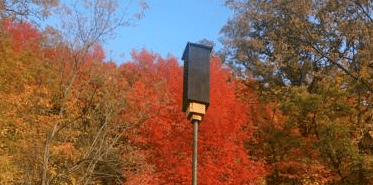
Community Meeting Follow-up: Ken Whillans- Bat Box Installation June 17, 2026

UPDATE: JULY 16, 2026

We are happy to report that staff have received a response from Ministry of Environment, Conservation and Parks (MCEP) regarding our request to relocate the bat habitat structures at Ken Whillans Park.

The MECP has advised that the relocation may proceed provided it does not interfere with the City’s conditional exemption un section 23.18 of O. Reg 242/08 under the Endangered Species Act (ESA) and that the relocation is carried out in compliance with the Species Conservation Act (SCA).

As required under the conditions of the City’s registration and the associated mitigation plan, activities that could affect bats must be undertaken outside of the applicable sensitive timing windows.

Accordingly, the bat habitat structures may be relocated after the bat exclusionary period ends on November 30.

Updated Next Steps:

  • The City and TRCA will undertake a site selection exercise to identify a few suitable locations for the bat habitat structures.
  • A map showing the proposed locations will be shared with Councillor Santos for review and to distribute to the residents who participated in the community meeting.
  • Following community feedback received through Councillor Santos, TRCA will install the new support poles (assuming September-October, pre-ground frost) at their new location.
  • After November 30, the existing bat habitat structures will be relocated to the newly installed poles.
  • Educational signage will be installed at the final location.

On Wednesday, June 17th, we held a virtual community meeting for residents to discuss the bat box installation on Ken Whillans Drive as part of the Riverwalk project. Thank you to all residents who joined and shared their questions, concerns, and feedback on this important issue.

We have consolidated all questions submitted by residents, both spoken during the meeting and submitted via chat and shared them with staff for response. Their answers will be incorporated into our public update and follow-up communications with residents.

Questions & Answers

“Since nothing has been done since you guys have reached out and you haven’t had any correspondence, this is where we can reach out because you don’t know who our contacts are. That’s all we need. We just tell us the right steps and we will follow them.”

As of July 14, the City has received a response from the MECP. The MECP has advised that any activities must not contravene the City’s project exemptions under the Endangered Species Act. As a result, the structures may ONLY be relocated after the bat exclusion window ends on November 30.

The City will identify potential relocation sites for residents to review and provide feedback on. Once a final location has been selected, residents will be notified.

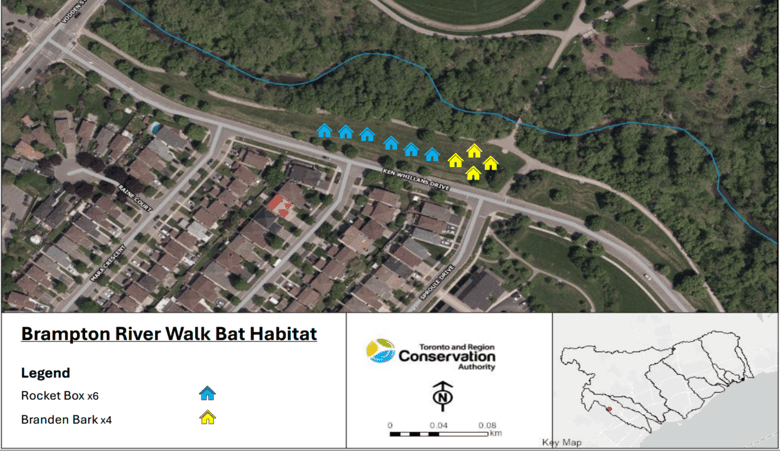
We understand that residents have concerns about the placement of these structures.  These structures are part of the City’s natural area management and are installed in the same manner as other wildlife habitat features throughout Brampton. Like the other habitat features, they do not require community approval before installation. In this case, the bat habitat structures also serve as habitat compensation under the project’s registration pursuant to the Endangered Species Act, and their locations were selected using ecological criteria, including proximity to removed bat habitat, surrounding woodland communities, solar exposure, proximity to permanent water, and overall suitability for Species at Risk bats.

Bat boxes are also widely used outside of municipal projects. They are commonly built and installed by homeowners, and conservation organizations to provide additional habitat for bats as their population is in decline. This information is available on various accredited sources:

An EIS addendum is typically required when a change affects the project’s overall scope, the nature or extent of its environmental impacts, or the conclusions of the original environmental assessment. The relocation of 10 of the 12 bat structures was a refinement within the boundaries of the already-approved Species at Risk Mitigation Plan. The new location was selected using the same ecological siting criteria as the original concept locations (proximity to impacted habitat, ecological community match, distance to water, treeline setback, sunlight exposure), and the number and type of structures, and the species they’re intended to support, did not change. Because the relocation didn’t alter the project’s environmental impacts or the mitigation approach itself, it was treated as a refinement during detailed design rather than a change requiring a formal EIS addendum.

The health risk associated with bat guano is generally linked to disturbing large accumulations of dried droppings in enclosed or heavily contaminated environments, not the small amounts typically associated with outdoor bat habitat structures. To further minimize any potential accumulation beneath the structures, guano collection trays have will be installed to catch any potential guano that falls.

The locations changed in February 2026 as construction planning was underway.

The City approved the final location at Ken Whillans Park as it fulfilled all of the siting characterizes identified in the EIS and SAR mitigation plan.

The locations were changed because the bat boxes would be in the middle of a construction zone. The City’s decision-making process for selecting new locations has been described in the answer to Question 2.

Clustering multiple bat structures together is a recognized best practice in bat roost design. Research and guidance from Bat Conservation International and other agencies show that bats are more likely to occupy roosts that are grouped together, generally three or more in a cluster because it allows them to move between structures to find the ideal temperature for raising their young as conditions change throughout the season and across the summer. A cluster of boxes functions, in effect, as a single roost site with multiple microclimates, which improves both occupancy rates and the health outcomes for maternity colonies.

Additionally, the very specific location requirements for placing the structures limited the current location as the most suitable.

The City looked at sites within and just outside of the impact area where the candidate maternity habitat trees were removed. This includes land within Ken Whillans Park, Central Park School, and Rosalea Park were considered.


The City does not seek resident approval to install wildlife habitat structures such as bird boxes, owl boxes, wood duck boxes, turtle nesting beaches, or bat structures, these are treated as standard infrastructure for parkland and natural area management and installed city-wide. In this case, the bat structures were also included in the Species at Risk Plan that was developed as a condition of the project’s Endangered Species Act registered exemption. We do acknowledge that earlier notice to nearby residents about the specific locations would have been preferable, and that’s feedback we’re taking forward.

There is no single Ministry clause that specifies these exact coordinates. What the Ministry registration requires is that the City develop and implement the Species at Risk Mitigation Plan, registered under Section 23.18 of Ontario Regulation 242/08 (Endangered Species Act). That plan sets out the ecological criteria the structures must meet proximity to the habitat being impacted, matching ecological land classification, distance to permanent water, treeline setback, and sunlight exposure which were developed using provincial Species at Risk guidance and recognized bat conservation standards. The City and TRCA identified the specific site as the location that best satisfies those criteria within the available project area; it was not dictated coordinate-by-coordinate by the Ministry. If the structures are relocated to a materially different site, that site will have to meet the same ecological siting criteria.

Per the Riverwalk Environmental Impact Study and Species at Risk Mitigation Plan, the Rocket Boxes and BrandenBark structures are designed to provide maternity roosting habitat for cavity and bark-roosting species specifically.

Little Brown Myotis and Northern Myotis are the primary Endangered species the structures are designed for as both rely on tree cavities (rocket boxes) and exfoliating bark (BrandenBark) for maternity roosting, which is exactly what’s been removed through tree clearing.

Human activity in the surrounding parkland was a factor in site selection. The structures were deliberately located outside of programmed recreation areas, away from active sports fields, playgrounds, and picnic tables, specifically to avoid placing them where people gather and spend extended time. This was combined with the ecological siting criteria to identify a location that worked both ecologically and from a public-use standpoint.

It’s also worth noting that bats were already present in the trees and valley system of the Etobicoke Creek corridor, in close proximity to this residential community, well before the Riverwalk project or these structures existed. The structures replace habitat being removed elsewhere in the corridor; they don’t introduce a new population of bats to the area.

On the question of health risk specifically: there is no published research measuring health outcomes tied to outdoor bat roost structures like these. The existing body of scientific research is almost entirely about bats already living inside homes and buildings, which these structures are specifically intended to reduce the likelihood of by giving bats a suitable outdoor alternative.

The bat compensation structures are not expected to increase the likelihood of bats entering nearby homes. Bats were already present within the Etobicoke Creek corridor and downtown Brampton prior to the installation of these structures, as confirmed through environmental studies completed for the Riverwalk project.

There is no evidence from similar compensation projects that bat roost structures cause bats to become disoriented and fly into houses. Bats use a natural navigation system called echolocation, where they make high-frequency sounds and listen for the echoes that bounce back from objects around them. This allows them to navigate in the dark and avoid obstacles such as trees and buildings.


Guano traps will be installed and inspected weekly throughout the maternity season, when bat activity is most likely. Each trap will be mounted on the pole directly beneath the bat box, positioned at a height that prevents public access. Based on outcomes from similar bat structures across Ontario, significant guano accumulation is not expected.

The City follows the guidance of Peel Public Health and the Province of Ontario regarding any public health matters involving bats. Bats are a naturally occurring wildlife species found throughout Brampton, Ontario, and North America, and public health guidance related to bats is established by provincial and public health authorities.

Should any future public health concerns arise, the City would work with the appropriate public health and regulatory agencies to ensure residents receive accurate information and direction.

  • As part of earlier works for Riverwalk, in Spring 2025, two bat rocket boxes were installed at Centennial Park, approximately 48m away from residential homes that back onto the park. This distance is comparable to the structures at Ken Whillans Park.
  • Claireville Conservation Area, nearest intersection: McVean Drive and Ebenezer Road directly across from a residential community.
  • Loafer’s Lake: Two bat boxes were installed in 2024. TRCA runs an annual community monitoring event to track bat activity with residents.

The conceptual design shared with the public reflected the information available at that stage of the design process. The bat habitat structure locations shown at that time were preliminary recommendations. As construction timelines evolved, and environmental mitigation measures were finalized, the locations were refined based on current site conditions, and ecological requirements.

The Riverwalk project has been planned for several years; however, detailed design is an iterative process. As ecological assessments, tree inventories, species at risk assessments, engineering design and construction staging progressed, mitigation measures (including the placement of bat habitat compensation structures) were refined.

The original structure locations were recommendations based on ecological conditions and project design at that time, recognizing that refinements may occur during actual construction and implementation.

Next Steps

1. Submitted the full list of consolidated resident questions to project staff for written responses.
2. Incorporate staff responses into a public update for residents.
3. Continue direct follow-up communication with residents on this project.

We appreciate residents taking the time to engage on this issue, and we remain committed to keeping you informed as we get answers from staff.

For any additional questions or concerns, please email us at rowena.santos@brampton.ca
 

Ref: 0